Committed To Quality, Committed To You
Plastic recycling has become a critical part of modern manufacturing and sustainability efforts. As the environment regulations are getting tough and there is an increase in the demand of recycled materials, industries are developing effective methods of recovering and reusing plastic waste without affecting the quality of the materials.
However, plastic recycling is not a simple process. The waste plastics contain various pollutants which include labels, dust, dirt, metal particles and mixed plastic fragments. Without these impurities being removed in the processing, they may interfere with the quality of the recycled plastic, destroy processing equipment and decrease the overall value of the item recycled.
This is where advanced screening technologies play an important role. By utilizing reliable sieving solutions from Galaxy Sivtek, plastic recyclers can effectively eliminate contaminants and separate their materials according to size; therefore providing consistent quality of their products throughout the entire plastic recycling process.
Plastic is highly applicable in the packaging, motor vehicle, construction, and consumer product industries. Consequently, there has been a lot of plastic waste generation during production as well as after the products have been used.
Recycling enables manufacturers to have less impact on the environment as well as to get back valuable raw materials that can be recycled in production.
Common sources of recyclable plastics include:
By implementing efficient recycling systems, manufacturers can significantly reduce raw material costs while contributing to circular economy initiatives.
The majority of plastic recycling plants adopt a systematic mechanical recycling procedure that aims at cleaning, sorting, and reusing plastic waste to manufacture reusable raw materials.
The recycling process begins with collecting plastic waste from various sources such as industrial manufacturing lines, packaging waste, or post-consumer products.
At this point, the materials are separated in terms of plastic type, colour, and composition. The right sorting of the plastics will make sure that incompatible plastics are not mixed in the re-cycling process, and this will help in preserving the quality of the end product of the re-cycling process.
Using automated sorting processes such as density separation and optical sorting technologies will help improve the accuracy and efficiency of the total sorting process.
After sorting, the plastic materials are washed thoroughly to get rid of dirt, adhesives, labels, oils and other contaminants.
The washing process is normally done in a number of stages such as cold washing, hot washing and rinsing. Before any further processing, the plastic material must be clean since remaining contaminants might interfere with the screening performance as well as downstream processing processes.
After washing, excess water is removed through mechanical dewatering and drying systems.
Clean plastic materials undergo size reduction when they enter shredders or granulators which produce smaller flakes or granules. This size reduction improves material handling and prepares the plastic for further processing.
However, during shredding and grinding, different particle sizes may be produced, including oversized flakes, fine dust, and irregular fragments.
Therefore, a subsequent screening step is needed to produce a single uniform size for use in subsequent recycling operations.
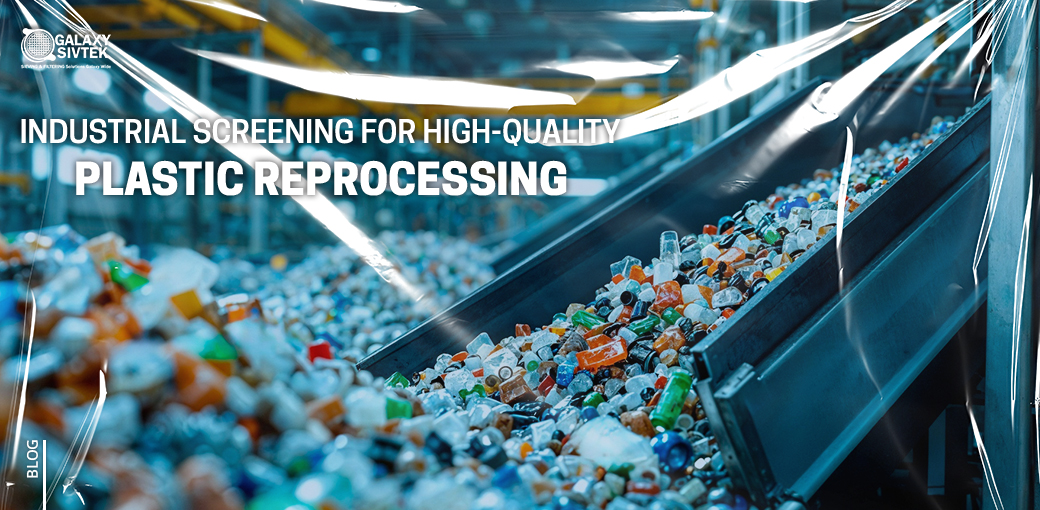
After shredding, plastic flakes and granules are passed through an industrial sieving machine to classify materials according to particle size.
Through the use of the Sivtek Vibro Separator screening equipment recyclers can successfully separate oversized plastic waste from properly sized plastic flakes. The vibratory movement of the machine enables the smaller particles to go through the screens mesh and the large or undesired material to remain.
This screening stage helps remove:
Screening establishes a standard particle size distribution which enables downstream processes like extrusion and pelletising to operate with greater efficiency.
In certain applications for recycling plastics, the plastic flakes will be further ground into powder (fine powder) for use in processes such as rotational moulding, compounding or blending with other plastics.
The current stage requires fine powder screening to create exact particle size distribution while eliminating ultra-fine dust and agglomerates.
For these applications, manufacturers typically rely on a high-efficiency screening system like the Sivtek Super Gyro Separator. This equipment produces strong vibration forces necessary for precise fine powder plastic separation and high rates.
Fine screening helps ensure:
This step is particularly important for industries where recycled plastic powder must meet strict quality specifications.
After the plastic flakes or powders are screened well, they are then moved in the extrusion systems where the plastic is melted and then made into homogeneous pellets.
During extrusion, the material is heated, filtered, and forced through a die before being cut into pellets. These recycled pellets can then serve as raw material for creating new plastic products.
Uniform particle size achieved during effective screening helps to maintain uniform extrusion performance and will contribute to producing uniformly sized pellets.
Screening has become a very important aspect of the plastic recycling process since it is directly related to the quality and usefulness of the recycled material.
Effective screening helps manufacturers achieve:
The screening process must be conducted properly because it determines which impurities will remain in recycled plastic materials which will result in product defects.
The operation of plastic recycling facilities benefits from advanced screening equipment which offers multiple operational advantages.
The system enables plastic recyclers to achieve three main goals through its operation which include:
Modern plastic recycling systems depend on screening technology which serves as a fundamental element of their operation.
Recycling of plastics helps a great deal in mitigating the effect on the environment and reclaiming useful materials to be reutilized in other production. Nevertheless, the recycling processes are largely affected by the quality of the material classification process and the elimination of contaminants.
The integration of advanced screening technology, including the Sivtek Vibro Separator and the Sivtek Super Gyro Separator, provided by Galaxy Sivtek, will ensure the efficiency of the screening process, particle sizes, and quality of the recycled materials.
Under the circumstances of ever-increasing focus on sustainability and resource efficiency in industries, effective screening solutions will also be one of the determinants in facilitating high-performance plastic recycling operations.