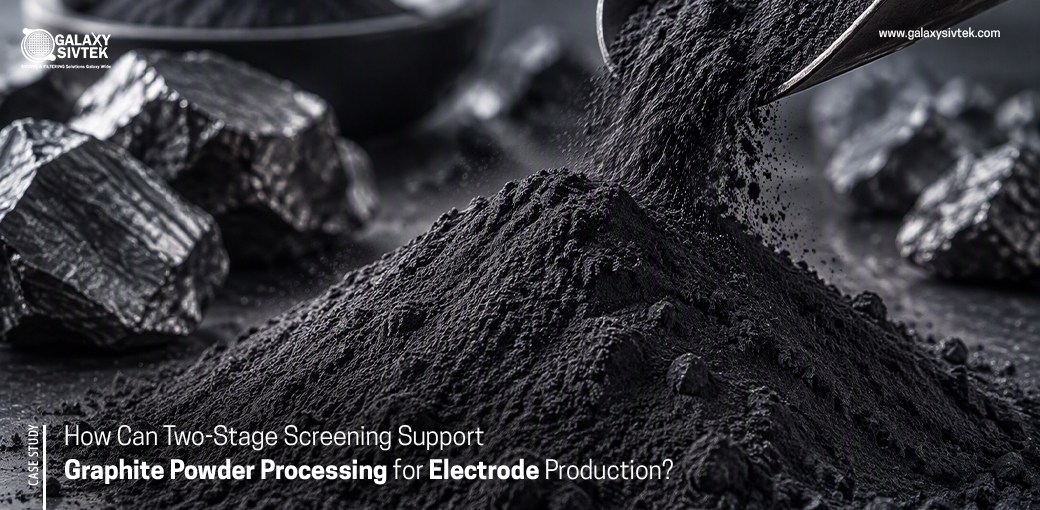
Case Study: Two-Stage Graphite Powder Screening for Electrode Production
Overview
In electrode manufacturing, graphite powder must meet defined size requirements before it moves into downstream production. When the required fractions are not separated consistently, material can fail internal quality checks, return for re-screening, and slow the overall process.
A leading electrode manufacturer was facing exactly this issue. Graphite batches were being rejected by the quality department because the existing screening arrangement was not delivering consistent separation. Re-sieving the same material added processing time and unnecessary handling.
The challenge was not limited to one screening stage. After hammering, the graphite needed to be classified into multiple grades. Once the required fraction was crushed further, the material then required a much finer screening step before it could move forward for electrode production.
The Challenge: Different Screening Requirements at Different Stages
After the initial hammering stage, the graphite contained different particle-size fractions that needed to be classified before further processing.
The existing screening system was not achieving that separation consistently, leading to repeated quality rejections and re-sieving.
The problem became more difficult after the selected graphite fraction was crushed further. At this stage, the powder became much finer, and particles began blocking the mesh openings. This reduced the effective screening area and restricted throughput.
The application therefore involved two separate challenges:
- accurate multi-grade classification after hammering, and
- fine graphite powder screening after crushing without frequent mesh blockage.
A single screening approach would not have addressed both requirements effectively.
Galaxy Sivtek’s Two-Stage Screening Solution
Before recommending the equipment, Galaxy Sivtek studied the customer’s graphite material and conducted trials at its facility to understand its actual screening behaviour.
Graphite is a naturally occurring form of crystalline carbon valued for its electrical conductivity, which makes it suitable for electrode-related applications.
Based on the trials, Galaxy Sivtek recommended a two-stage screening configuration, with each machine assigned a different role in the process.
Stage 1: Multi-Grade Classification
For the first stage, a two-deck Vibro Sifter was selected to classify the graphite immediately after hammering.
The machine separated the material into three different grades, allowing the required fractions to be identified before further processing.
The objective at this stage was not simply to remove oversize material. The manufacturer required controlled classification into multiple usable fractions before selected material moved to the crushing stage.
Stage 2: Fine Screening After Crushing
Once the required graphite grade was crushed further, the screening requirement changed.
The finer graphite powder now had to be screened to the desired final size, while the mesh-blockage issue also had to be addressed.
For this stage, Galaxy Sivtek recommended a single-deck Vibro Separator equipped with a Sivtek® deblinding system.
The deblinding system helps keep the fine mesh openings clear during screening, reducing the tendency of graphite particles to block the apertures and restrict the available screening area.
The complete process therefore operated in sequence. Graphite from the hammering stage was first passed through the two-deck Vibro Sifter, where it was classified into three grades. The required fraction was then sent for further crushing. After crushing, the finer graphite powder was screened again through the single-deck Vibro Separator fitted with the Sivtek® deblinding system to achieve the required particle size for electrode production.
Each machine was configured for a specific purpose rather than expecting one unit to handle two very different material conditions.
The customer’s technical team also evaluated the proposed Vibro Separator against its internal quality requirements before approving both systems for installation.
Why the Two-Stage Approach Worked
The first stage focused on multi-grade classification, while the second focused on fine screening and mesh deblinding.
Separating these two functions gave the manufacturer greater control over the graphite at each stage of processing.
The two-deck Vibro Sifter handled the different particle-size fractions generated after hammering, while the post-crushing Vibro Separator addressed the finer material and the mesh-blockage issue associated with it.
Instead of forcing one screening machine to manage both requirements, the process was configured according to how the graphite changed during production.
Results
After installation, the customer reported an improvement in the quality of the graded graphite material.
The Sivtek® deblinding system also addressed the mesh-blockage problem that had previously restricted fine screening. With more of the mesh area remaining available during operation, throughput at the post-crushing stage improved.
The customer also reported that cleaning and disassembly of the equipment required less time than with the previous arrangement.
Overall, the two-stage solution helped:
- improve graphite grading quality,
- reduce the need for repeated re-sieving,
- minimise mesh blockage during fine screening,
- improve throughput at the post-crushing stage,
- and simplify machine cleaning and disassembly.
Conclusion
Graphite screening for electrode production cannot always be handled as a single separation step. As the material moves through hammering, classification and further crushing, its screening requirement changes.
For this application, Galaxy Sivtek addressed those changing requirements with a two-stage screening approach: a two-deck Vibro Sifter for multi-grade classification, followed by a single-deck Vibro Separator with a Sivtek® deblinding system for fine post-crushing screening.
By matching each screening stage to the actual condition of the graphite, the manufacturer achieved more consistent grading, reduced mesh-blockage issues and improved preparation of graphite powder for electrode production.
Talk to Galaxy Sivtek’s experts to evaluate the right screening solution for your graphite application.