Committed To Quality, Committed To You
Activated carbon can carry fine particles and dust through manufacturing, handling, and subsequent processing. For manufacturers producing a defined carbon grade, those fines need to be separated from the desired product fraction before the material moves on to further processing or packaging.
Activated carbon de-dusting is not just taking out unwanted fines – it’s doing this at all times, without halting the necessary material flow or affecting the product specification. A continuous vibro screening system can be used to remove fine particles directly from the production process, rather than being separated by hand on an irregular basis, for a plant that operates on an industrial scale.
Activated carbon comes in several forms — powder, granules, and pelletized carbon — and fine particles can mix into the desired fraction at any of them during processing and handling. Left in the product, those fines affect the consistency of the finished material and make it harder to hold the required particle-size specification.
The objective is straightforward: separate the unwanted fine carbon particles from the required fraction while keeping the main product moving continuously through the process — without stopping the line, and without treating fine-particle removal as an occasional cleanup task bolted onto grading.
When fines stay mixed with the desired fraction, they travel further downstream into processing or packaging. For manufacturers working to a defined particle-size spec, that creates inconsistency in the finished product. Fine material also tends to accumulate around processing and packaging areas, making general material handling and housekeeping harder than it needs to be.
That’s why fine-particle separation belongs in the production process itself, not as an occasional cleanup task. The stakes go up on a continuous line — stopping production just to clear accumulated fines introduces exactly the kind of interruption and extra operator involvement a continuous process is designed to avoid.
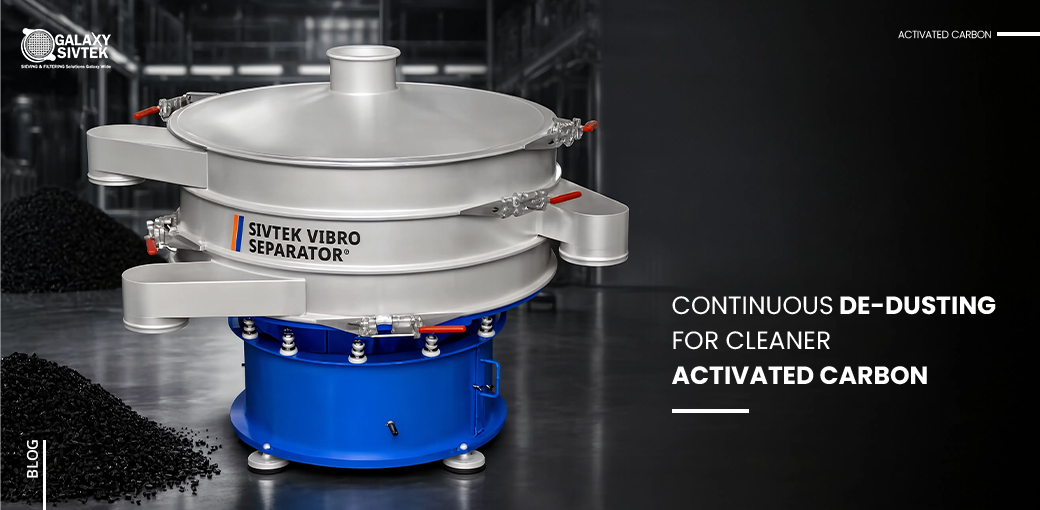
A vibro separator moves activated carbon across a screening mesh using controlled vibration. As material travels across the screen, particles smaller than the selected mesh opening pass through while the required larger fraction continues toward the product outlet — creating a continuous separation between the fines and the desired carbon.
The Sivtek Vibro Separator® is built for exactly this kind of application — screening, scalping, de-dusting, filtering, and gradation — and can be configured with multiple screening decks when more than one particle-size separation is needed in a single pass. The advantage on a continuous line is straightforward: fine-particle removal becomes part of the material flow itself, rather than a separate manual step someone has to manage.
Pelletized or extruded activated carbon — sometimes called carbon bullets — presents its own version of this challenge. Fine particles mix into the pellets during handling and need to be separated before the material moves on to the next stage.
Galaxy Sivtek has demonstrated exactly this: de-dusting carbon bullets with a vibratory round separator, continuously separating fine carbon particles from the pelletized product on a working line. It’s a useful, practical reference for how continuous screening handles fines without disrupting the pellet fraction — and a reminder that screening technology needs to be evaluated against the actual physical form of the carbon being processed, not treated as one-size-fits-all.
Powdered activated carbon presents a different version of the same challenge, since the material itself starts out fine — and fine particles interact with a screening mesh differently than larger carbon particles do, which makes the screening configuration a real decision rather than an afterthought.
Galaxy Sivtek’s sieving activated carbon trial shows this in practice — a Sivtek Vibro Separator® screening activated carbon powder, separating out the required fraction as part of the process. The underlying screening principle carries across powder, granules, and pellets; what changes is the machine configuration needed to match the material.
Not all screening equipment handles fine, friable activated carbon in the same way. For a de-dusting application, manufacturers will need to consider the efficiency of the equipment during continuous production:
The value of a continuous approach isn’t just cleaner carbon — it’s a screening stage that never becomes the reason production has to stop. Fine particles come off the line as fast as they’re generated, mesh performance holds up across a full run instead of degrading as fines accumulate, and the equipment configuration — single deck or multiple, round separator or another vibro design — gets matched to whichever carbon form is actually running, powder, granules, or pellets.
Removing fine carbon particles is a real, ongoing consideration for any manufacturer working to a defined specification, and the goal is doing it continuously without the screening stage becoming a bottleneck of its own. Galaxy Sivtek works with activated carbon manufacturers to evaluate screening requirements and identify the right de-dusting configuration for the carbon form, target particle size, and production rate involved.