Committed To Quality, Committed To You
In starch processing, achieving high throughput is only part of the challenge. The real difficulty lies in maintaining consistent screening performance while handling materials that behave very differently under production conditions.
This becomes especially important when plants process both native starch and modified starch on the same production line.
At first glance, both materials may appear similar. They are fine powders, both require controlled particle sizing, and both demand contamination-free processing. But operationally, they behave very differently during screening. A sieving machine that performs efficiently for native starch may struggle when handling modified starch under continuous industrial loads.
This is where many starch manufacturers begin facing recurring production issues — mesh clogging, unstable material flow, excessive dusting, inconsistent throughput, and repeated manual cleaning interventions. As production capacity increases, these problems become more expensive and harder to manage.
That is why manufacturers processing starch at industrial scale are increasingly moving toward application-specific starch screening solutions rather than relying on generalised sieving systems.
One of the biggest misconceptions in starch processing is assuming all starch powders behave similarly during sieving.
In reality, the screening behaviour of native starch and modified starch is quite different due to their particle structure, moisture sensitivity and flow properties.
Generally native starch is a lighter, free flowing powder. The primary problem in high-capacity operations is the ability to maintain a constant screen throughput and not allow fine powder to build up and excessive airborne dust to occur during screening.
Modified starch behaves differently. Due to chemical or physical modification processes, it tends to show greater moisture sensitivity and a stronger tendency toward agglomeration. Under continuous production conditions, this often results in irregular material movement, soft lump formation, and progressive mesh blockage.
This is where many conventional vibro sifters begin losing efficiency. Throughput gradually drops, mesh blinding increases, and operators are forced to stop the line repeatedly for manual cleaning.
The issue is rarely the mesh alone. In most cases, the real problem is that the screening technology is not optimized for the material behaviour.
Modern starch plants operate under very different production expectations compared to traditional batch-processing environments.
Today, manufacturers require:
In large-scale operations, even small interruptions in screening efficiency can create major production bottlenecks downstream.
It is particularly important in high capacity starch powder screening applications, the screening machine should be able to continue to work without the loss of production efficiency during the long production period.
Traditional vibration-only systems may perform adequately at moderate production volumes, but industrial-scale starch processing often demands more stable and continuous material handling.
That’s where a starch processing industrial roto sifters play their most important role in performance.
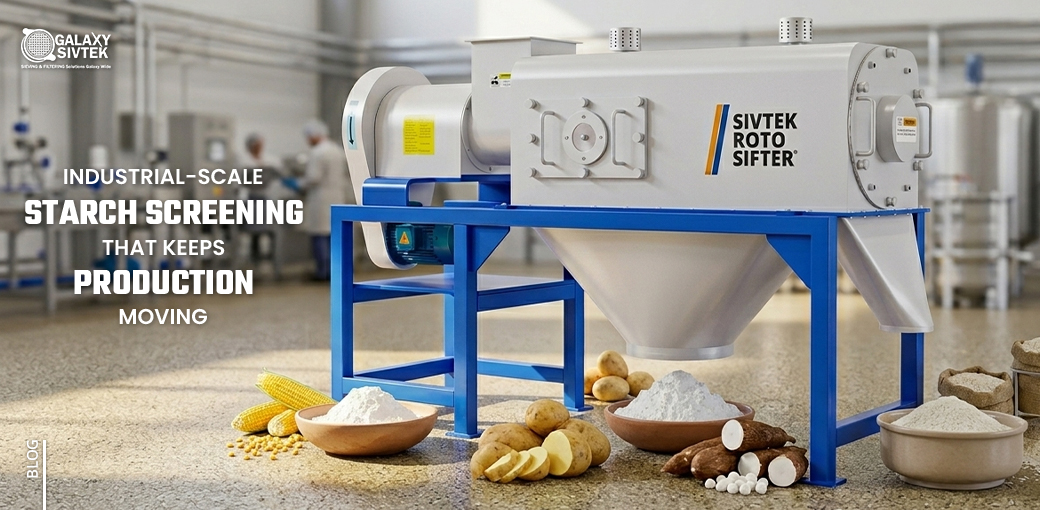
Ideal for high capacity powder screening applications with a consistent throughput and efficient material handling, the Sivtek Roto Sifter 1350 is engineered for continuous screening.
In contrast to traditional vibro sifters that utilize only vibration motion, the Sivtek Roto Sifter 1350 operates on the centrifugal principle of moving powder through the cylindrical screening surface. Gentle rotation of paddles will move material through the mesh and control the product flow during the screening process.
This creates a measurable advantage when processing both native and modified starch.
For native starch, the machine supports high-throughput screening while minimising excessive powder dispersion and maintaining smoother product movement. For modified starch, the controlled centrifugal motion reduces blockage caused by lumping or stickiness and supports more stable mesh performance during long production runs — regardless of how the starch has been modified.
The outcome is a reliable screening process that minimizes the need for constant manual mesh cleaning.
Galaxy Sivtek has partnered with various manufacturers of starch products, regardless of their size and market location, including tapioca and maize starch manufacturers as well as factories that produce corn starch, where previous manual sieving had caused continuous problems of mesh tearing, dusting, and inconsistent flow-through. In each case, the transition to the Sivtek Roto Sifter 1350 resolved these issues through centrifugal screening action, enclosed dust-free operation, and a durable mesh basket designed for continuous industrial use.
In starch processing plants, getting the screening configuration “right” tends to mean, directly:
The compact, inline-friendly design of the Sivtek Roto Sifter 1350 also allows easier integration into existing production lines without requiring excessive floor space — an important consideration for expanding starch manufacturing facilities.
As starch manufacturers continue scaling operations, the focus is shifting from basic screening toward complete process optimization.
Manufacturers are no longer evaluating sieving machines only based on whether they can separate material. Evaluations include assessing if the machine can provide stable throughput, minimize manual handling, and achieve continuous production efficiency even through extended operational runs.
This change is one of the big reasons centrifugal sifters for starch powder are being picked more often in industrial starch processing areas.
For plants processing both native and modified starch, roto sifters offer a balance of throughput efficiency, controlled material handling, continuous inline operation, and reduced mesh blinding — all of which become critical at an industrial scale.
Most importantly, they help plants maintain operational consistency without depending heavily on operator adjustments to keep the process stable.
The Right Screening Machine Makes the Difference
Native starch and modified starch may appear similar during production, but their screening behaviour is fundamentally different. Often using the same screening technique on both materials results in unnecessary downtime, throughput problems and eventual inefficiencies.
The Sivtek Roto Sifter 1350 is designed specifically to handle these industrial-scale starch screening challenges through continuous centrifugal screening, stable material flow, and high-capacity performance.
If your current starch screening setup is causing recurring clogging, unstable throughput, or excessive manual cleaning, it may be time to evaluate whether the right screening technology is being used for your process.
Connect with Galaxy Sivtek to identify the most efficient screening solution for your starch application.